6701.
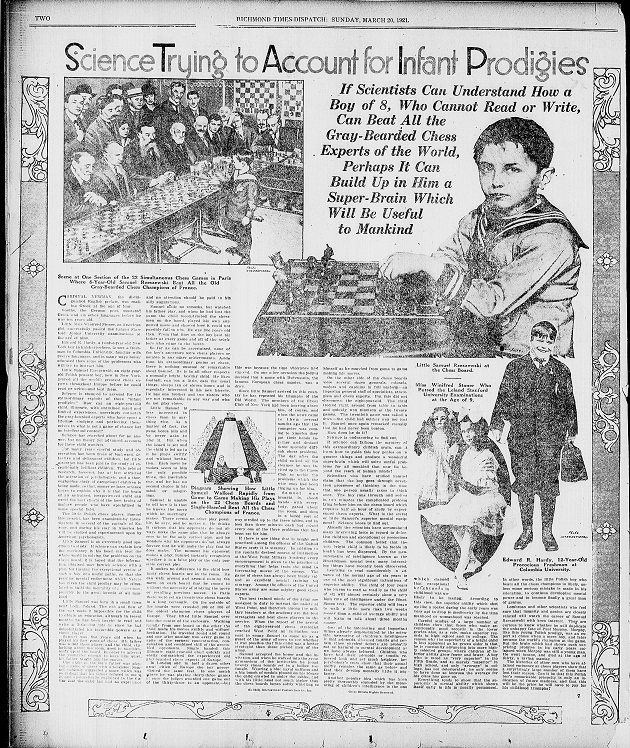
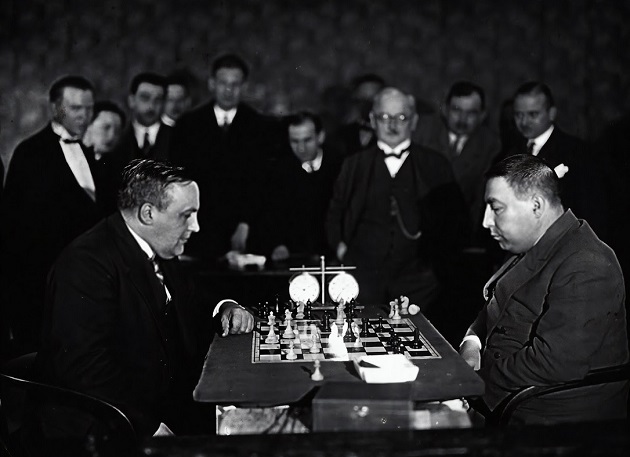
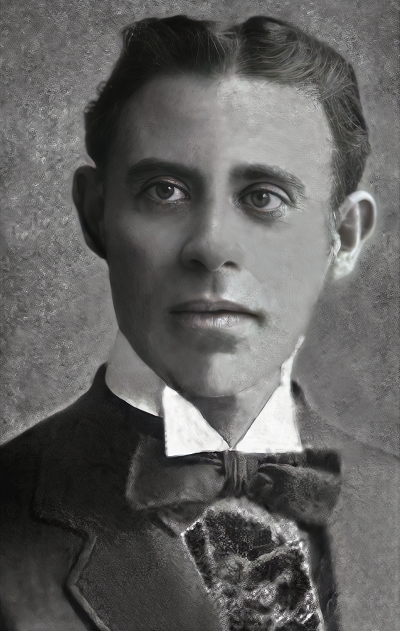
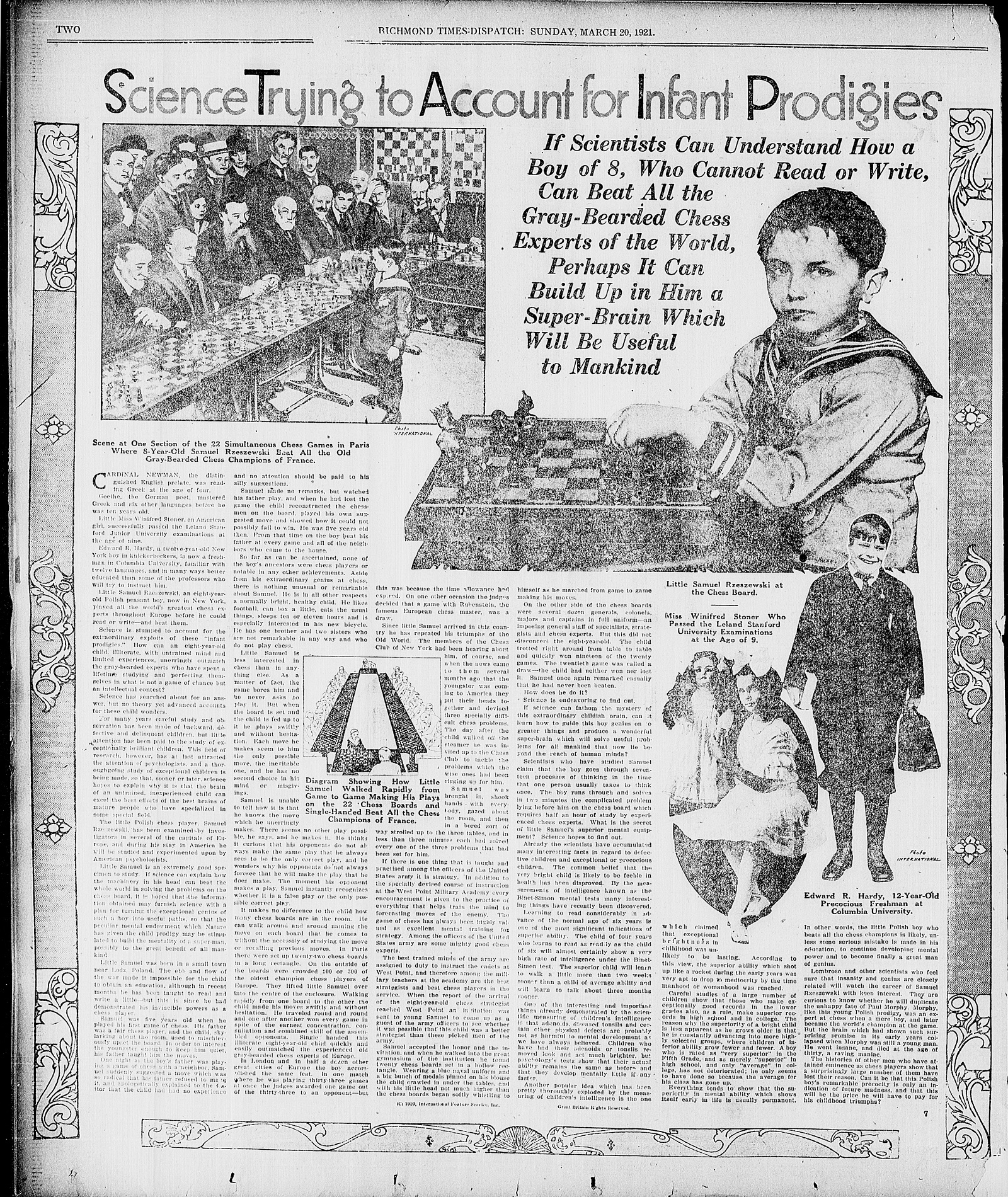
Early Reshevsky photograph
This
particularly early photograph of Reshevsky, from page 6 of Wiener
Bilder, 30 September 1917, has been
submitted by Jan Kalendovský (Brno, Czech Republic):
6702.
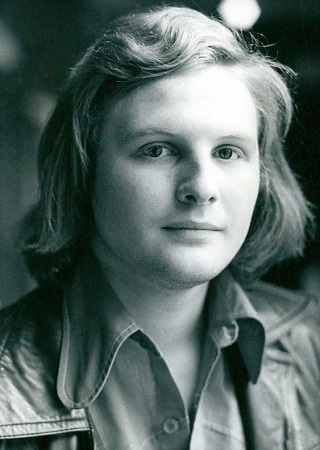
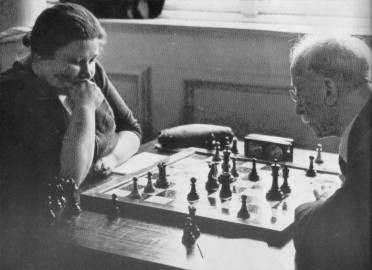
Tigran Petrosian
Mr
Kalendovský also draws attention to a photograph of Petrosian
(signed
by the master overleaf) in his collection:
6703.
Alain White Collection (C.N. 6678)
From
Michael Clapham (Ipswich, England):
‘C.N.
6678 mentioned that the Alain White Collection was housed in the
South Africa National Library. However, this is a collection not of
A.C. White’s own chess books but of about 500 volumes compiled by
Donald G. McIntyre and named after A.C. White.
That
information comes from the Special
Collections section of the
National Library of South Africa website.’
Our
correspondent asks what became of A.C. White’s own chess book
collection, which numbered ‘somewhat less than 2,000 volumes’ in
1907, according to an article by White on page 38 of the Chess
Amateur,
November 1907.
6704.
Alekhine quotation
Wanted: substantiation of this ‘once’ quotation:
‘Alekhine
once said, “There must be no reasoning from past moves, only from
the present position”.’
Source: The Golden Dozen by Irving Chernev (Oxford,
1976), page
260.
6705.
Stamma book
Robert
John McCrary (Columbia, SC, USA) writes:
‘My
copy of Stamma’s The
Noble Game of Chess (London, 1745),
which introduced the algebraic notation to the
West, has the bookplate of the “Marquis Townshend”. I found that
the first Marquis was the brother of the man who authored the
“Townshend Acts”, which were among the sparks that helped bring
on the American Revolution. The Marquis title was first conferred on
the family some years after 1745.
I
wonder whether my copy belonged to that first Marquis. His son, who
inherited the title, was an avid book collector.’
Among
the subscribers to Philidor’s Analyse du jeu
des échecs was ‘M. Townshend’.
6706.
A mate in three by Nimzowitsch (C.N.s 6696 & 6700)
Kagans Neueste
Schachnachrichten, March 1932, page 70
From
Peter Anderberg (Harmstorf,
Germany):
‘The
mate in three was published in Nimzowitsch’s chess column on page 6
of the Baltische
Zeitung
of 11 December 1918, in an article dealing with smothered mate.
(Note that the white king is on c1.)
A
number of articles from Nimzowitsch’s column in that publication were
reprinted in my article “Aaron Nimzowitsch
und die Baltische Zeitung”
in Kaissiber,
October-December
2007, pages
54-65.’
6707.
Nimzowitsch the candidate
As
an addition to Nimzowitsch
the ‘Crown Prince’ we note the following on pages 179-180 of The
100
Best
Chess
Games
of
the
20th
Century,
Ranked
by
Andrew Soltis (Jefferson, 2000):
‘Aron
Nimzovich had an ego problem. After Carlsbad, 1929 he added a sign to
his apartment door that read: CANDIDATE FOR THE WORLD CHAMPIONSHIP.
“So you won’t forget?”, he was asked. “So that the chess
world doesn’t forget”, he replied.’
No
source was offered.
6708. Nardus
Patrick Neslias (Esse, France) provides two photographs of Léonardus
Nardus from his collection:
Léonardus Nardus (left)
and an
unnamed
opponent
Left to right: Frank James
Marshall,
Léonardus Nardus,
Marie Gendreau (governess) and Pierre
Boucherle (painter and friend of Nardus)
Mr Neslias informs us that
in October 2010 his book Butin Nazi, dealing with Nardus’
final period in Tunisia, will be published by Geste éditions.
6709.
Additional
pictures
We are grateful to Patrick Neslias
(Esse, France) for additional illustrations from his
collection, including two Marshall items and the
‘other’ Carlsbad, 1929 group photograph (which was referred to in C.N.
5372):


6710. Rubinstein in Brussels
Concerning Akiba
Rubinstein’s Later Years
Martin Weissenberg (Savyon, Israel)
draws attention to a passage on page 123 of Histoire des
maîtres
belges by M. Wasnair and M. Jadoul (1988):
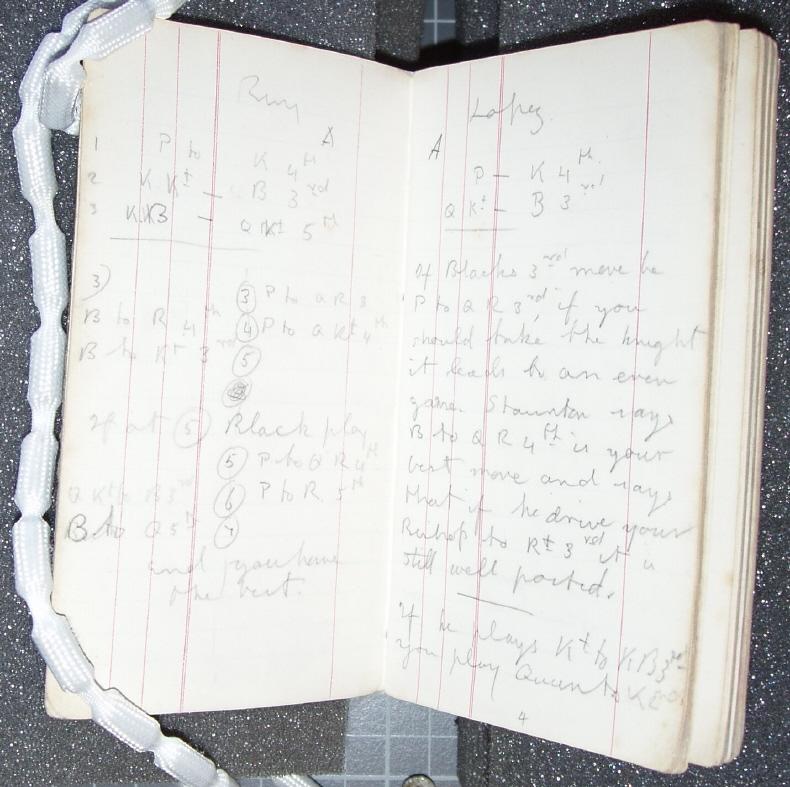
‘Après
la guerre, O’Kelly et Devos rendaient régulièrement
visite à Akiba Rubinstein qui avait élu domicile à
Bruxelles. Malade, absent, les yeux éteints, le grand A.
Rubinstein reprenait vie devant l’échiquier. Comme le
contait Devos, “ses yeux s’allumaient sitôt l’échiquier
installé”. Rubinstein et O’Kelly ont joué ensemble
des dizaines de parties sur le même thème: 1 é4
é5 2 Cf3 Cc6 3 Fb5 Fç5 (le système Cordel de la
partie Espagnole). L’étude approfondie de cette variante
où
O’Kelly conduisait toujours les noirs, deviendra l’une de ses
armes favorites. L’enseignement des parties jouées avec A.
Rubinstein, mais surtout son travail personnel, permettront à
O’Kelly de passer du niveau de bon maître national à
celui de maître international et enfin à celui de grand
maître.’
Did
either O’Kelly or Devos write any articles about their meetings
with Rubinstein?
6711.
Marshall v Mieses
John
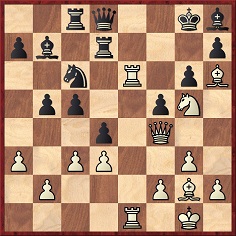
Blackstone (Las Vegas, NV, USA) notes that on page 7 of the 16
December 1908 issue of the New York Evening Post Emanuel
Lasker gave a version of the seventh match-game between Marshall and
Mieses (played in Berlin on 28 November 1908) which deviated from the
commonly-published score.
Lasker’s text was repeated on
page 63 of the December 1908-January 1909 issue of Lasker’s
Chess Magazine, and for reasons of legibility that is the version
reproduced here:
The game-score as regularly presented elsewhere
is
below
(with, in square brackets, observations by Mr Blackstone on the
differences from Lasker’s
version):
1
d4 d5 2 c4 e6 3 Nc3 c5 4 cxd5 exd5 5 Nf3 Nc6 6 g3 Be6 7 Bg2 Nf6 8 Bg5
Be7 9 dxc5 Qa5 10 O-O Qxc5 11 Rc1 O-O 12 e4 Qa5 13 Bxf6 Bxf6 14 exd5
Rad8 15 Qb3 Bxd5 16 Nxd5 Rxd5 17 Qxb7 Nd4 18 Nxd4 Rxd4 19 a3 Rd2 20
b4 Qxa3 21 Bd5 Bc3
22 Bxf7+ [‘22 Rb1 Rb2 23 Rxb2 Qxb2 24 b5 Qe2
25 Bxf7+ Kh8 is the line given by Lasker.’] 22...Kh8 23 Rb1 Rb2
24 Rxb2 Qxb2 25 b5 Qe2 [‘Now the lines come back together.’]
26 Qxa7
Qxb5 27 Qe3 Qb4 28 Bd5 Bd4 29 Qe2 Qb2 30 Qxb2 Bxb2 31 Kg2 Rd8 32 Rb1
Rxd5 33 Rxb2 h5 34 f4 Kh7 35 Kh3 g5 36 Rb7+ Kg6 37 Rb6+ Kf5 [‘37...Kg7
38
Rb7+
Kg6
39
Rb6+
Kf5
40
Rh6
was
given
by
Lasker.’] 38 Rh6 h4 39 Rh5 Kg6 40 Kg4 hxg3 41 hxg3 [‘This
is where Lasker states that Black resigned.’] 41…Kf6 42 Rxg5
Rxg5+ 43 fxg5+ Kg6 44 Kh4 Kg7 45 Kh5 Kh7 46 g6+ Kg7 47 Kg5 Kh8 48 Kh6
Resigns.
The 48-move version was given in various magazines of the
time, an
example being Deutsches Wochenschach, 13 November 1908, pages
449-450. Even so, Lasker was in Berlin at the
time of the game. His column in the Evening Post was headed
‘Berlin, 2 December’, and the introductory text too was reproduced in Lasker’s
Chess
Magazine (on page 40 of the above-mentioned
issue).
6712. Barden
in the Evening Standard
Leonard
Barden (London) informs us that his daily (Monday-Friday) chess
column in the London Evening Standard began in early June 1956.
Apart from one week in May 2009 when it appeared on-line only, the
column continued in the newspaper until 30 July 2010. Since then, it
has been published exclusively on-line.
Has
there ever been, in any journalistic field, such a run for a daily
column by a single individual?
Leonard Barden (Chess Life,
August
1962,
page
169)
6713. Judd v Showalter
Eduardo Bauzá Mercére
(New York, NY, USA) sends the third
game in the Judd v Showalter match, as published on page 5 of the New
York Sun,
13 December 1891, and asks whether the score is correct. In
particular, do other sources explain Black’s resignation or
mention 38...Qxd6 and 40...Rd3 as possibilities?
Max Judd – Jackson Whipps Showalter
Third match-game, St Louis, 10 December
1891
French Defence
1 e4 e6 2 d4 d5 3 Nc3 Bb4 4 Bd3 c5 5
Bb5+ Nc6 6 exd5 Qxd5 7 Nf3 Nf6 8 O-O Bxc3 9 bxc3 cxd4 10 Bxc6+ bxc6
11 cxd4 O-O 12 Re1 Nd7 13 Qd3 Rd8 14 Ng5 Nf8 15 Nf3 Ng6 16 c4 Qh5 17
Qe4 Rb8 18 Bf4 Nxf4 19 Qxf4 Ba6 20 Re5 Qg6 21 Rc1 Rb1 22 Ree1 Rxc1 23
Rxc1 Qd3 24 Qc7 Rf8 25 Qxc6 Qa3 26 Re1 Qxa2 27 Ne5 Bc8 28 d5 Qa5 29
Nf3 exd5 30 cxd5 Bg4 31 Rc1 h6 32 Rd1 Rc8 33 Qb7 Qa4 34 Rf1 Qf4 35 h3
Rb8 36 Qxa7 Bxf3 37 gxf3 Rb3 38 d6 Rxf3 39 d7 Qg5+ 40 Kh2 Resigns.
6714. Chess and life
From page 1 of Lessons in Chess,
Lessons in Life by Jose A. Fadul (Morrisville and London, 2008):
‘Somebody complained that life is too
short to be wasted in trivial games such as chess. But William Napier
did retort that such is the fault of life, and not of chess.’
The retort is indeed sometimes
attributed to Napier (for example, in a piece which appeared under
Frank Elley’s name on page 30 of Chess Life, March 1986),
but we do not recall seeing it in Napier’s writings.
As noted in The Most Famous
Chess
Quotations, ‘Life’s too short for chess’ was a line of dialogue
in the play Our Boys by H.J. Byron. Our feature article on Sir
John Simon quoted from page 116 of CHESS, 14 December 1937:
‘Deputizing for Sir John at the
Sheffield Cutlers’ Feast recently, Dr Burgin, Minister of
Transport, referred to the Chancellor’s partiality to chess and
added, “Of chess it has been said that life is not long enough for
it – but that is the fault of life, not of chess”.’
We commented that the longer quote is often attributed to
Irving
Chernev, who gave it (without claiming paternity) on page 108 of The
Bright
Side
of
Chess (Philadelphia, 1948). Moreover, the book’s
layout created the false impression that Chernev was ascribing
the remark to Napier.

Another case of confusion arising from the layout of
quotes in that section of The
Bright Side of Chess is the ‘conferred sight’ remark
attributed to Capablanca (see C.N. 4209).
On page 313 of the October 1969 BCM
D.J. Morgan listed ‘Life is too short for chess, but that is the
fault of life, not chess’ as an unnamed reader’s entry in a
‘Views on Chess’ competition run by Brian Harley. It was published in
the Observer
of 31 October 1937.
6715. Rose quote (C.N. 5462)
In the above-mentioned BCM item
D.J. Morgan stated that the winning entry in the 1937 Observer
competition was from Professor H.J.
Rose:
‘Intimate conversation without a word
spoken; thrilling activity in quiescence; triumph and defeat, hope
and despondency, life and death, all within sixty-four squares;
poetry and science reconciled; the ancient East at one with modern
Europe – that is chess.’
This is relevant to the discussion of the quote, and its
author, in C.N. 5462.
A famous remark, it was
reproduced on page 17 of The Big Book of Chess by Eric
Schiller (New York, 2006) with only two mistakes (‘quiescent’ and
‘poetry and signs’).
6716.
Tom Wiswell
Tom
Wiswell has been mentioned in several C.N. items, and now Gene
Gnandt (Houston, TX, USA) draws our attention
to the checkers master’s appearance on an edition of the television
game-show What’s
My
Line?
broadcast on 21 February 1954 (starting at about 5’30”
into the segment).
6717. Reshevsky
group shot
Robert Sherwood (E.
Dummerston, VT, USA) points out this photograph on page 23 of
the February 1921 American Chess Bulletin:
6718. Nimzowitsch’s lamentation (C.N.
5019)
Justin
Horton (Huesca, Spain)
comments that many Internet pages place Nimzowitsch’s alleged
lament about losing to ‘this idiot’ (Sämisch) not in Berlin,
as stated by Kmoch, but at Baden Baden, 1925.
Half-way
through that tournament Nimzowitsch did indeed lose to Sämisch,
but what evidence exists that such an incident occurred there?
6719.
Wendel
v
Nimzowitsch
Javier Asturiano Molina (Murcia, Spain)
asks for information about the exact occasion when the famous game
Wendel v Nimzowitsch (‘Stockholm, 1921’) was played.
Nimzowitsch described it as ‘one of my best
games’, and it has been widely printed and praised. For instance, on
pages 6-8 of Irving Chernev’s The
Golden
Dozen (Oxford, 1976) it appeared with the following introduction:
‘There are deep, dark and mysterious
moves in this exotic game that could only have been produced by a
strange, original genius.’
The game was published (headed ‘Stockholm, 1921’, but without
further details) on pages 8-10 of
the January-February 1922 issue of the Swedish magazine Tidskrift
för Schack, with Nimzowitsch’s annotations:
Acknowledgment: Calle Erlandsson (Lund,
Sweden) and Peter Holmgren (Stockholm).
A different set of notes by
Nimzowitsch appeared on pages 148-150 of Kagans Neueste
Schachnachrichten, 1 April 1925:
In the German
magazine the heading stated that it was a ‘match game’. There was
no such reference in a third set of notes by Nimzowitsch, on pages
128-130 of his book Die Praxis meines Systems (Berlin, 1930):
In none of these publications did
Nimzowitsch identify White by more than his surname, but the player is
almost certainly Verner Wendel (1893-1940), who has an
entry in Jeremy Gaige’s Chess Personalia. He was active in
Stockholm chess circles during the period in question and participated
in a
tournament in that city, with Nimzowitsch, in October-November 1920.
From page 203 of the
November-December 1920 Tidskrift för Schack:
That
same issue had Nimzowitsch’s notes to games by Wendel against Olson
and Spielmann, but neither of Nimzowitsch’s
victories against Wendel in the tournament was given.
Nor has any reference to a Nimzowitsch v Wendel match been found in
the Swedish magazine or elsewhere.
It may thus be wondered whether the Wendel v
Nimzowitsch game under discussion was, in fact, played in the
Stockholm tournament of October-November 1920, and not in 1921 as
stated by Nimzowitsch. In that case, though, Nimzowitsch could have
been expected to publish ‘one of my best
games’ in the Tidskrift
för Schack of the time, i.e. together with his wins against
Olson, Spielmann and Jacobson from the Stockholm, 1920 tournament
(which he did annotate in the
November-December 1920 edition of the magazine). However, as shown
above, his notes to
the
Wendel v Nimzowitsch game were not published until the January-February
1922 issue.
If, therefore, the date 1921 for the Wendel v Nimzowitsch game
is correct after all, an event in which it could have occurred
remains to be identified.
6720.
Alekhine quotation (C.N. 6704)
C.N.
6704 asked for substantiation of this quote attributed to Alekhine:
‘There must be no reasoning from past moves, only from the
present position.’
Dan
Scoones
(Port Coquitlam,
BC, Canada) refers to comments by Alekhine in his 1938 radio interview
(see C.N. 5838): ‘Look
forward all the time is the thing to do.’ ... ‘I never look back
on a game or a match but try all the time to see how I may improve my
play.’
From
Dominique Thimognier
(Fondettes, France) comes an article ‘Ce
que nous disait Alekhine!’
by Louis Betbeder, which was published in a brochure for the 1967
French championship. One
piece of advice by Alekhine (in Betbeder’s reported speech and
under the heading ‘Objectivité
du jugement’)
was:
‘Savoir
si l’on est mieux que l’adversaire est, par conséquent,
essentiel; se poser très souvent la question, en particulier
pendant qu’il réfléchit. Juger surtout une position
en oubliant complètement l’histoire de la partie et en ne
considérant que la géographie, c’est-à-dire le
diagramme actuel.’
6721.
Reshevsky group shot (C.N. 6717)
Olimpiu
G. Urcan (Singapore) mentions that a better copy of the
Reshevsky photograph can be viewed in the Cleveland Public
Library
Digital Gallery.
6722.
Peter Reid
A
question from Calle Erlandsson
(Lund, Sweden): are any photographs available of the Scottish player Peter
Reid (1910-1939)?
6723.
Weak enough
From
page 109 of The
Bright Side of Chess by Irving
Chernev (Philadelphia, 1948):
‘Nimzowitsch
described someone as “An amateur who played a weak enough game to
enable him to conduct an important chess column”.’
Chernev
gave no further details, but the words appeared on page
261 of Nimzowitsch’s book The Praxis of My System
(London, 1936). The translation, by J. du Mont, omitted the name of
the columnist in question, but it had been given on page 180 of the
original edition, Die Praxis meines Systems
(Berlin, 1930):
The
name also appeared on page 154 of a recent English translation (by
Ian Adams) of Nimzowitsch’s book, published under the title Chess
Praxis (Glasgow, 2007):
The
report of Wilhelm Therkatz’s death on page 12 of the January 1925 Wiener
Schachzeitung
stated that he had conducted the chess column in the Krefelder
Zeitung for 26 years.
6724.
Wood
v
Ritson
Morry
Our Chess in the Courts
article
quoted
the following from page 161 of CHESS, August 1954:
‘Chess Criminal Charge
B.H. Wood was acquitted at Birmingham
Assizes on 14 July, without calling upon any evidence, of a charge of
criminal libel instituted by W. Ritson Morry. In a letter to a Mr
Golding, Mr Wood had indicated that if Mr Morry was in the new Welsh
Chess Union, Mr Wood was out; he referred to Mr Morry as “this
ex-gaolbird”. It was held that Mr Wood was entitled to give his
reasons for withdrawing; that the description was true, as Morry,
after misappropriating clients’ money as a Solicitor some years
before, had been sentenced to 18 months’ imprisonment.
The Commissioner stated that in his
opinion the case should never have been brought, and awarded B.H.
Wood costs not exceeding £100.’
James Plaskett (Cartagena, Spain) asks
whether further details are available on Ritson Morry’s offence.
We note from Google
Books (snippets shown by a search for
‘Ritson Morry’ and ‘solicitor’) that 1940s law reports had information
on the case. Could a reader with access to the documents supply an
account of the proceedings?
6725. Chernev quote
‘Every chess master was once a
beginner’ is an observation regularly credited to Irving Chernev. Where
did
he write it?
6726. Michaelis gamelet (C.N. 2860)
Rick Kennedy (Columbus, OH, USA) is
seeking more information about a game which we reproduced in C.N.
2860 from page 79 of Beadle’s
Dime Chess Instructor by
M.J. Hazeltine (New York, 1860):

Otho E. Michaelis – ‘Mr S.’
New York (date?)
(Remove White’s queen’s rook.)
1 e4 e5 2 Nf3 Bc5 3 Nxe5 Qe7 4 d4 Bb6 5
b3 d6 6 Ba3 Qd8 7 Nf3 Bg4 8 Bd3 d5 9 O-O Nf6 10 Re1 dxe4 11 Bxe4 Bxf3
12 Bc6 mate.
6727.
B.
Niemzowitsch
C.N. 2273 (see page 26 of A Chess
Omnibus) asked for biographical information about the problemist
B. Niemzowitsch and gave this mate-in-three from page 587 of Die
Schwalbe, November 1933:
We have received the
following from Per Skjoldager (Fredericia, Denmark), who, as
mentioned in C.N. 3506, is co-authoring with Jørn Erik Nielsen a
book on Aron Nimzowitsch:
‘Aron Nimzowitsch had three
younger brothers, and Benno (or Benjamin) was the youngest. He was
born on 14 May 1896 (new style) and by the first of his two marriages
he had a son, Isay-Erik (born in Berlin on 28 July 1928).
Benno lived in Berlin for several years, before moving to Langfuhr,
Danzig. He was a strong chessplayer as a boy but put his efforts
into problem composition. Because of his Jewish background, he had to
flee from the Nazis, and he finally went back to Riga. The Nazis killed
the
entire family in 1941.
Benno Niemzowitsch
(photograph
courtesy of Per Skjoldager)
In our collection we have more than
30 problems by Benno Niemzowitsch. For the most part they are self-mate
compositions, but there are also a few direct-mate problems. His
first composition on record was published in the Baltische
Zeitung of 2 October 1918, in Aron Nimzowitsch’s chess
column (“Erstabdruck”):
Mate in four
When this problem was given on page 95 of Skakbladet,
June
1936
the
pawn
on
g7
was
missing,
and
the
composition
was
ascribed
to
Aron
Nimzowitsch.’
6728. Blumenfeld v
Nimzowitsch
Mr Skjoldager informs
us that the Nimzowitsch book mentioned in the previous item is due to
be published in 2011 and he adds:
‘An early game between Benjamin
Blumenfeld and Aron Nimzowitsch, Berlin, 1903 (1 e4 e5 2 Nf3 Nc6 3 d4
exd4 4 Nxd4 Nf6 5 Nxc6 bxc6 6 Bd3 d5 7 e5 Ng4 8
O-O Qh4 9 h3 h5 10 Bf4 Bc5 11 Qd2 Rb8 12 Nc3 Rb4 13 Bg5 Qg3 14 hxg4
hxg4 15 Rfe1 Rh2 16 Bf1 Rh8 17 Bd3 Rh2 18 Bf1 Bxf2+ 19 Qxf2 Rh1+ 20
Kxh1 Qxf2 21 Re2 Qg3 22 Rd1 Bf5 23 Nxd5 cxd5 24 Rxd5 Rb8 25 e6 fxe6
26 Rxf5 Kd7 27 Rf7+ Kc6 28 Rxe6+ Kb7 29 Kg1 Resigns) can be
found on the Internet, but we have not been able to trace a source for
it.
We believe that it is probably a
“real game”, partly because Nimzowitsch played this particular
variation of the Scotch Game in his youth and partly because he was
acquainted with Blumenfeld during his early years in Berlin. We have
looked through all possible chess columns and all contemporary German
periodicals, as well as Blumenfeld’s books, without
success, but the game may have been published by him in a
Russian/Soviet chess magazine. Can anyone find it?’
6729. Caroline Marshall letter
Patrick Neslias (Esse, France) provides
from his collection a letter sent by Caroline Marshall to
Léonardus
Nardus announcing her husband’s death:
Below is the photograph referred to by Mrs Marshall,
reproduced from
page 2 of the
December 1944 Chess Review:
6730. Antoniadi games
Further to our feature article on E.M.
Antoniadi, Dominique Thimognier (Fondettes, France) has submitted
three games published in Les tablettes du chercheur in 1894
(pages 162, 176, 194 and 195):
6731.
Lasker problem
Jan
Kalendovský (Brno, Czech Republic) sends a straightforward
problem
(mate in three) composed by Emanuel Lasker for young solvers which was
published on
page 32 of the Neue Freie Presse, 22 December 1935:
6732.
London, 1922
A
serious disservice is done to chess history by some ‘modern’
editions of old tournament books. The latest example is London
1922 by G. Maróczy (Milford, 2010), which not only
discards the original book’s introductory material but brushes out
the editor and publisher, W.H. Watts, and a master, Amos Burn,
who annotated at least 18 of the games.
In
the original edition, games featuring Burn’s annotations (games
41-44, for example) ended with the specific reference ‘Notes from The
Field’:
On
page 5 of the original edition Watts gave an explanation indicating
that the total number of games annotated by Burn, as
opposed to Maróczy, might well be even higher than 18:

6733.
Wood v Ritson Morry (C.N. 6724)
David
McAlister (Hillsborough,
Northern Ireland) inform us:
‘There
are a number of Law Reports on the criminal proceedings brought
against Ritson Morry. However, they all report not the trial
itself but his unsuccessful appeal against conviction heard by the
Court of Criminal Appeal on 29 October 1945. His grounds of
appeal were essentially concerned with legal technicalities, and the
judgment of the three-judge Court of Criminal Appeal (delivered by Mr
Justice Hilbery) does not go into details about the criminal charges
which Morry faced. It merely states:
“At
the summer assizes at Birmingham, on 26 July 1945, the appellant was
tried on an indictment containing four counts charging him with
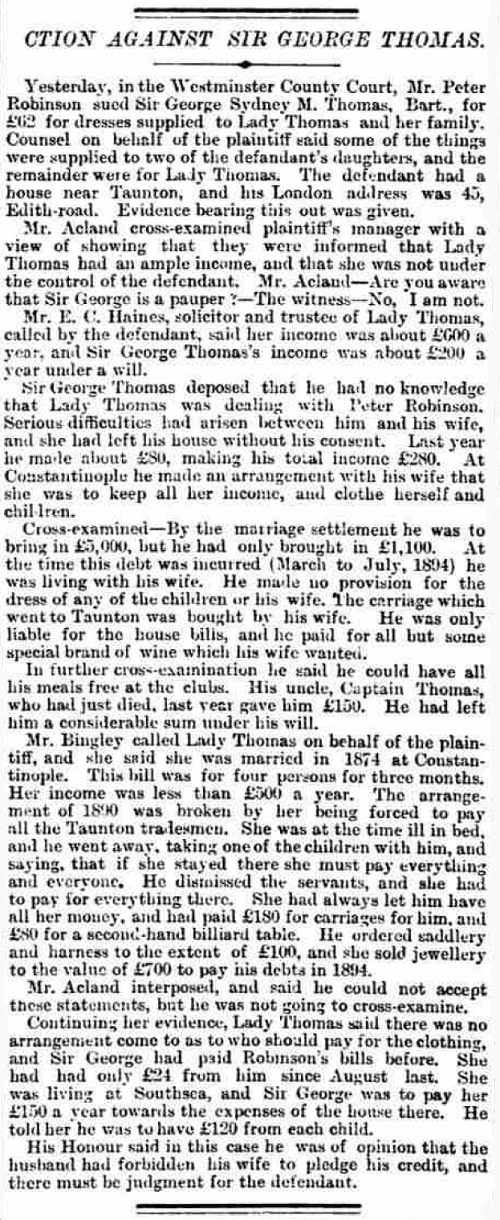
fraudulent conversion of four sums of money totalling £3,136.
He was convicted on all counts, and sentenced to 18 months’
imprisonment.”
This
passage appears on page 633 of Volume 2 of the All England Reports
for 1945. The complete report is on pages 632-636 and was cited
by lawyers as R. v Morry [1945] 2 All ER 632.’
6734.
Young masters
From page 168 of the July-August 1931 Kagans Neueste
Schachnachrichten:
6735. Ödön Gesztesi (C.N.
6520)
Dominique
Thimognier (Fondettes, France) has found an article by Louis
Mandy on pages 51-52 of the May-June 1955 issue of L’Echiquier
de Paris.
Entitled ‘La
Rennaissance Echiquéenne’,
it discussed the chess magazine of that name, which was edited by
Gesztesi/Gestesi during its brief run (March-July 1912).
Mandy’s
article included some biographical information about him and this
picture, a detail from a photograph taken during a simultaneous
exhibition in Sceaux
on 24 November 1911:

6736. Wood v Ritson Morry (C.N.s 6724
& 6733)
Paul
Timson (Whalley, England) provides further details:
‘As
mentioned by David McAlister in C.N. 6733, the only references to
Ritson Morry in the Law Reports relate to a decision of the Court of
Criminal Appeal on 29 October 1945,
before
Hilbery, Wrottesley and Stable,
the appeal being based on technical legal grounds. I offer a summary
below.
At
the summer assizes at Birmingham on 25-26 July 1945 the appellant,
William Ritson Morry, a solicitor, was tried on an indictment
containing four counts charging him with fraudulent conversion of
four sums of money totalling £3,136. He was convicted on all
counts and sentenced to 18 months’ imprisonment.
He
appealed against his conviction on a number of technical legal
grounds and represented himself at the Court of Criminal Appeal.
One
of the grounds of appeal was that when he was committed for trial by
the magistrates’ court the magistrates, as they were obliged to
do, asked him the question laid down by statute: “Do you wish to
say anything in answer to the charge? You are not obliged to say
anything unless you desire to do so, but whatever you say will be
taken down in writing and may be given in evidence upon your trial.”
In
response to that question he took the opportunity to make a speech,
lasting some three hours, as an advocate on his own behalf. He now
appealed on the grounds that because every word of his speech was not
taken down and certified, the committal was irregular and the whole
indictment should have been quashed.
The
Court of Criminal Appeal held that the procedure of calling upon the
accused to make a statement if he chooses at that stage in the
proceedings, where the magistrates are considering whether or not a
case is made out for committal, was never intended to apply to a man
making an oration as an advocate on his own behalf. They therefore
dismissed this ground of appeal.
Another
ground of appeal was that the magistrates had refused to commit him
for trial on the charges which were the subject of counts one and two
in the indictment. The trial judge had, however, decided that these
counts should be included in the trial, as well as counts three and
four (on which the magistrates had committed him), and the appellant
was duly convicted on all four counts.
The
Court of Criminal Appeal held that this was a matter for the trial
judge to decide, and his decision could not be questioned.
The
appeal was therefore dismissed, and the Court held that the sentence
of 18 months’ imprisonment would run from the date of conviction,
namely from the first day of the assizes (25 July 1945).
The
Wood v Ritson Morry case was reported in the Times newspaper
on 7 April 1954,
when B.H. Wood was committed for trial, and on 15 July 1954, when he
was acquitted on the charge of criminal libel.
The offending
paragraph of Wood’s letter to Henry Golding, dated 23 February
1954, was quoted by the Times:
“Your
whole attitude makes it clear that you are a Morry stooge. When you
have become in due time disillusioned about this ex-gaolbird and have
returned to sanity please contact me again unless you are so fed up
that you drop out of chess altogether as some have done.”
The
7 April 1954 report in the Times
stated:
“Mr
Morry said that at one time he practised at Sutton as a solicitor. ‘I
fell on evil times, however, and was sentenced to 18 months’
imprisonment for fraudulent conversion, which I served and returned
to public life’, he said. He had put himself at right with the
world and was entitled to live at peace with it. The use of the
expression ‘ex-gaolbird’ with its highly defamatory meaning was
in itself sufficient to maintain a conviction for criminal libel,
submitted Mr Morry.”
That
report also quoted two officials of the British Chess Federation, Sir
Leonard Swinnerton Dyer and George Wheatcroft, as stating that they
were aware of Morry’s past conviction but had had no objection to
his holding office in the Federation.
From
personal knowledge I can give a fuller answer to James
Plaskett’s question in C.N. 6724. I studied law at Birmingham
University from 1965 to 1968 and whilst there I played in the
Birmingham chess league at a time when B.H. Wood and W. Ritson Morry
(both also graduates of Birmingham University) were still playing in
the league. I had several long conversations with Wood, who was
President of the University Chess Club and, as I recall, it was he
who told me the story of Ritson Morry’s downfall. In the late 1930s
Ritson Morry, who was a solicitor, invested clients’
money without their knowledge or consent in a speculative property
development. He was convinced that the development would make a large
profit and he would be able to replace the clients’ money and take
the profit for himself. Unfortunately for Ritson Morry, with the
outbreak of the Second World War the development collapsed and he
lost all the money which had been invested. As he was unable to
replace his clients’ money from his own resources, they reported
the matter to the police as soon as they became aware of the
situation, and this resulted in his eventual conviction and
imprisonment, and also in his being struck off the roll of
solicitors.
He did eventually repay the money.’
The photograph below (showing the English players who went to
Holland to play a Dutch team) comes from page 296 of the June 1937 BCM:

6737. Wendel v Nimzowitsch (C.N. 6719)
C.N. 6719 asked whether the Wendel v Nimzowitsch game under
discussion (which began 1 e4 Nc6 2 d4 d5) was perhaps played in the
double-round tournament in Stockholm,
October-November 1920.
Maurice Carter (Fairborn, OH,
USA), who has a book on Nimzowitsch in progress, informs us that that
possibility can be discounted, given that he owns
Nimzowitsch’s score-sheet of the game against Wendel in
which Nimzowitsch was Black. The heading provided by our
correspondent is shown below:
6738.
Lasker
and New York, 1927
From
pages 222-223 of ‘Garry Kasparov on My Great Predecessors Part I
with the participation of Dmitry Plisetsky’ (London, 2003):
‘To
the super-tournament in New York (1927), arranged to “accommodate”
Capablanca, Lasker was no longer invited.’
Zenón
Franco
Ocampos (Ponteareas, Spain) asks whether this is true. The
answer is no, because Lasker was invited to New York, 1927.
We
discussed the matter on pages 195-197 of our book on Capablanca,
referring to the bitter public dispute which had arisen at New York,
1924 between Lasker and Norbert Lederer (the latter being a key
figure on the organizing committees of New York, 1924 and New York,
1927).
Much
additional information was presented in the article ‘New York 1927
Documentary Evidence Answers Lingering Questions’ by Hanon Russell
on pages 88-104 of the first issue of the American Chess Journal
(1992). A section of the article (pages 99-101) was headed ‘Why
Didn’t Lasker Play?’, and it showed that although the New York,
1927 organizing committee did not believe that Lasker would
participate, Lederer ...
‘... made
an
extraordinary effort to convince Lasker to play. He enlisted the
help of influential people in the United States and Europe, but
Lasker was not persuaded. Finally, as the plans which were formulated
had to be finalized, Lederer made one last effort. On 10 December
1926 he wrote a five-page typewritten letter in German to Lasker
(Russell Collection #584). Lederer, whose first language was German
(he was born in Vienna), wanted to make absolutely certain that he
would not be misunderstood. Lederer’s formal invitation to Lasker
specified all the terms, financial and otherwise, being offered to
Lasker as well as a strong plea for Lasker to relent and play in what
was recognized even then as one of the world’s great chess
tournaments.’
Lasker
refused
the invitation.
See
also pages 74 and 640 of Emanuel Lasker Denker Weltenbürger
Schachweltmeister edited by R. Forster, S. Hansen and M. Negele
(Berlin, 2009).
6739.
Young masters (C.N. 6734)
Richard
J. Hervert (Aberdeen, MD, USA) and Alan
McGowan
(Waterloo, Canada) comment that the caption in Kagans
Neueste
Schachnachrichten
is faulty, since Pirc is standing second from the right. (A photograph
of the young Pirc was given in C.N. 6131.)
On
the subject of photographs from Kagans
Neueste Schachnachrichten,
the following appeared on page 56 of the March 1932
edition:
Daniël Noteboom
Page 48 of the February 1932 issue stated that the photograph
had
been given
to Kagan by Euwe.
6740.
Morphy
at
the
Opera
Regarding the game Morphy v
the Duke
and Count and the correct spelling of the
Count’s name, Kevin O’Connell (Mouret, France) informs us:
‘1.
Vauvenargues
(Vauvenarga or Vauvenargo in the Provençal
language, which was still dominant in the area in the 1870s) is a
village in Provence. Vauvenargues is the French version, but the
village is located in Occitania and so has its Occitan name, but
there are six dialects, of which Provençal is one. Within
Provençal there are two orthographical
norms, one of which
gives “Vauvenargo” and the other “Vauvenarga”. The latter
would almost certainly be favoured today.
2.
The
château, bought by Picasso in 1958, belonged to the Isoard
family from 1790 to 1943. Information is available under “Histoire
et patrimoine” at the website of the Mairie de Vauvenargues.
3. In
all variants of Occitan (including Provençal) “o” is
invariably pronounced “ou” unless it has a grave accent (ò),
in which case it should be pronounced like the “o” in Opéra.
4.
In
spelling the Count’s name today, there is certainly some
latitude, but I suppose that it should officially be Comte Isoard de
Vauvenargues, in recognition of the considerable success of the
French authorities (during the approximate period 1870-1930) in
almost stamping out the language of the people of the southern half
of France, even though it is 99% certain that his name was pronounced
“Isouard”.’
6741.
Alekhine
v Sämisch
Pages
14-15
of 100 Classics of the Chessboard
by A.S.M. Dickins and H. Ebert (Oxford, 1983) gave Alekhine v
Sämisch,
Berlin, 1923 under the heading ‘The Classic Blindfold Game’. The
co-authors claimed:
‘Happening to meet in Berlin, the two players
decided to take the opportunity of playing each other blindfold,
creating as a result this astonishing brilliancy.’
The book added that
Sämisch called Alekhine’s victory
‘the most brilliant game I have ever seen’. The moves: 1
e4 c5 2 Nf3 Nc6 3 Be2 e6 4 O-O d6 5 d4 cxd4 6 Nxd4 Nf6 7 Bf3 Ne5 8 c4
Nxf3+ 9 Qxf3 Be7 10 Nc3 O-O 11 b3 Nd7 12 Bb2 Bf6 13 Rad1 a6 14 Qg3
Qc7 15 Kh1 Rd8 16 f4 b6 17 f5 Be5 18 fxe6 Bxg3 19 exf7+ Kh8 20 Nd5
Resigns.
It
is one of Alekhine’s most spectacular miniatures, number 97 in his
first collection of Best Games (London,
1927). The heading was ‘Exhibition Game played at Berlin, February
1923’.
The book did not suggest that either master was blindfold. Nor
did the German translation, Meine besten Partien 1908-1923
(Berlin and Leipzig, 1929), although we have one later edition in
German (Berlin, 1983), which states ‘Beiderseits ohne Ansicht des
Brettes’. Various editions of the book Meisterspiele
by Rudolf Teschner say that both
players were without sight of the board, and Sämisch’s
praise of Alekhine is quoted:
‘“Die
genialste
Partie, die ich je gesehen habe”, äußerte
Sämisch voll Bewunderung für seinen Gegner.’
As
shown below, Tartakower cited Sämisch when he published the game
(a ‘Gastkampf’
, which Tartakower dated 1921, instead of 1923, with no
intimation of blindfold play but with an additional move at the end) on
page 276 of Die
hypermoderne
Schachpartie (Vienna,
1924):

January,
rather than February, 1923 was specified when the game appeared on
pages 218-219 of the second volume of Complete
Games
of
Alekhine by V. Fiala and J.
Kalendovský (Olomouc, 1996). The co-authors asserted that the
game was first published on page 16 of the Observer,
4 March 1923. In neither that volume nor in the Skinner/Verhoeven
book on Alekhine (see page 184) was it suggested that Alekhine
or Sämisch played the game blindfold. Moreover, the score was
not included in Blindfold Chess
by E. Hearst and J. Knott (Jefferson, 2009).
The brilliancy is absent from all the chess magazines
of
1923 that we have consulted so far.
6742. William Hartston in Now!
Throughout the run
of the weekly news magazine Now! (September
1979-April 1981) there was a fine chess column by William Hartston.
Some quotes are offered below:
- ‘...
combinations are much easier to find if you know they are there. If
only those magic words “White to play and win” would light up
below the board, we would all win so many more games. In real life
most of the sacrifices are not correct; only the fantasy world of the
chess columnist has flashy finishes to games ...
Some
years ago I was playing in the Hastings tournament with Mikhail Tal.
One
evening, he picked up an English newspaper, casually glanced at the
chess column and started laughing. What had attracted his attention
was the position given for readers to solve: it was from his own game
against Platonov played at Dubna in 1973.
The
amusement, however, was caused by the set of par solving times
appended in order to rate one’s achievement in finding the answer.
These began at 20 seconds, indicating grandmaster strength, then
proceeded via master, county player and club player to stop at
“average” – five minutes. “That’s very funny”, said Tal.
“I spent 15 minutes looking at the position before I saw it, and my
opponent didn’t see it at all.”’ (4-10
January 1980, page 98.)
The
position in question was given:

White (Tal) to move
- ‘You
can tell a great deal about a chessplayer by the way he looks at the
board when it is his turn to move. Spassky always wears the bored
expression of a man in a bus queue, in no particular hurry. Korchnoi,
on the other hand, looks as though he is in danger of missing his
train, while Karpov has the confident pose of one who knows that the
train will wait for him even if he is late. But this week, we shall
be talking about Polugayevsky. He looks as though he is the only one
with a timetable, cannot understand why the bus was not there ten
minutes ago, and is about to panic and run for a taxi.’ (11-17
July 1980, page 88.)
- ‘Modern
grandmasters, of course, are far superior in technique and
understanding, but games from the distant past have a feeling of
spontaneous enjoyment and a quest for brilliance which is generally
lacking in today’s sophisticated world. ...
Such
a game as this [the famous Steinitz Gambit brilliancy won by Robert
Steel from the 1880s] gives the impression that calculating ability and
imagination in chess are no better now than they were 100 years ago.
The game is far more scientific, of course, but for sheer flair and
inventiveness such nineteenth-century brilliancies remain practically
unparalleled in modern play.’ (25-31
July 1980, page 88.)
- ‘I
met the eponymous professor [Arpad E. Elo] during the chess olympics
at Nice in 1974. He was besieged with requests by players wanting the
rules bent to accommodate their own requests for international
titles. When the last of the supplicants had gone, Professor Elo said
to me: “I think I have created a monster.” I think so too.’ (1-7
August 1980, page 82.)
- ‘Even
when games are annotated by the players themselves, most fall victim
to the temptation to justify their decisions rather than explain
them. Chess is not a precise science or even a totally logical game.
Only after the result is decided do the annotators feel obliged to
present the decisions in black and white. ...
All
the more enjoyable therefore to come across the rare example of
totally honest annotators of their own games. Of today’s great
players I put complete trust in Larsen and Tal.’ (8-14
August 1980, page 82.)
- ‘One
reason for the wide appeal of chess lies in the ambiguous nature of
the game. Some claim it is a sport, others view it as a science while
many try to elevate chess to the level of art. I have always taken
the view that chess is primarily a sport masquerading as a minor art
form.’ (3-9
October 1980, page 80.)
- ‘Some
time ago the great Russian player David Bronstein gave me this
advice: “Look at the games of Gordon Crown. He really understood
chess”.’ (6-12
February 1981, page 80.)
6743. Michaelis gamelet (C.N.s 2860 & 6726)
John Hilbert (Amherst, NY, USA) notes that the gamelet was
published in
the New York Clipper,
8 September 1860, introduced as follows:
‘An
exceedingly curious mate given by our contributor Otho E. Michaelis
giving QR.’
6744.
Lasker
v
Lederer
(C.N. 6738)
From Eduardo
Bauzá
Mercére
(New
York, NY, USA) comes a report
on page A10 of the Brooklyn Daily Eagle, 16 May 1929:
‘Lasker-Lederer Settlement
The
judiciary committee of the National Chess Federation, of which Judge
Jacob E. Dittus of Chicago is chairman, has adjudicated the
controversy between Dr Emanuel Lasker of Berlin, former world’s
champion and winner of first prize in the international masters’
tournament in New York, 1924, and Dr Norbert L. Lederer, director of
that tournament, according to advices received from Chicago.
Dr
Lederer had lodged a formal complaint against Dr Lasker with the
committee to the effect that Dr Lasker had published statements
reflecting upon his character, as well as upon the executive
committee of that tournament, and which, he declared, called for an
apology. Dr Lasker, it is said, agreed to abide by the findings of
the judiciary committee.
The
committee decided that Dr Lederer’s complaint was justified and
that the facts in the case did not bear out Dr Lasker’s
accusation. A report of the findings was sent to Dr Lasker.
Edward
Lasker,
recently
elected
secretary of the National Chess Federation,
said yesterday that he and other friends of Dr Emanuel Lasker felt
certain that the latter will acquit himself gracefully by publicly
retracting his charges. Dr Lasker became 60 years of age on 24
December last, an occasion which was fittingly celebrated by the
chessplayers of Germany.’
6745.
Confusion
over
a
Lasker game
John
Blackstone (Las Vegas, NV, USA) refers to a game given in
databases as won by Emanuel Lasker (White) in a simultaneous
exhibition in the Netherlands in 1908 against C.A. Moller:
1
e4 e5 2 Nf3 Nc6 3 Bc4 Nf6 4 d3 Bc5 5 Nc3 d6 6 Be3 Bb6 7 Qd2 O-O
8 O-O Be6 9 Nd5 Bxd5 10 exd5 Ne7 11 Bg5 Ng6 12 Nh4 Nxh4 13 Bxh4 Ne4
14 dxe4 Qxh4 15 Bd3 g6 16 Kh1 f5 17 g3 Qf6 18 f3 f4 19 g4 Rf7 20 Rae1
Qh4 21 Re2 g5 22 Rg2 Kg7 23 c4
23...Rd8 24 b4 Bd4 25 Qc2 b6 26 a4 Kf6 27
Qe2 h5 28 Rc1 Rh7 29 Rc2 Qh3 30 Ra2 Bc3 31 b5 hxg4 32 Rxg4 Be1 33 Rg2
Bg3 34 Rd2 Bxh2 35 Rxh2 Qg3 ‘1-0’.
Noting
that
the
game
was given in Lasker’s column on page 7 of the New
York Evening Post, 1 August 1908 as played in Copenhagen at 15
moves an hour, with Lasker as Black against C.A. Möller, our
correspondent asks, ‘Do you know the truth?’
This
is a further example of the unreliability of databases. The game as
given in the Evening Post also appeared on pages 99-100 of Lasker’s
Chess
Magazine, September 1908. Lasker won as
Black, and the game, played in Copenhagen, did not occur in a
simultaneous
display.
Moreover, both
the newspaper and the magazine had Black’s 23rd move as ‘QR-R’,
i.e. 23...Rh8 and not 23...Rd8 as given in the databases. With
23...Rh8 the
game’s conclusion makes sense.
Chess Notes Archives
Factfinder
Copyright: Edward Winter. All rights
reserved.
|